Introduction


Declarative deep learning framework built for scale and efficiency.




📖 What is Ludwig?
Ludwig is a low-code framework for building custom AI models like LLMs and other deep neural networks.
Key features:
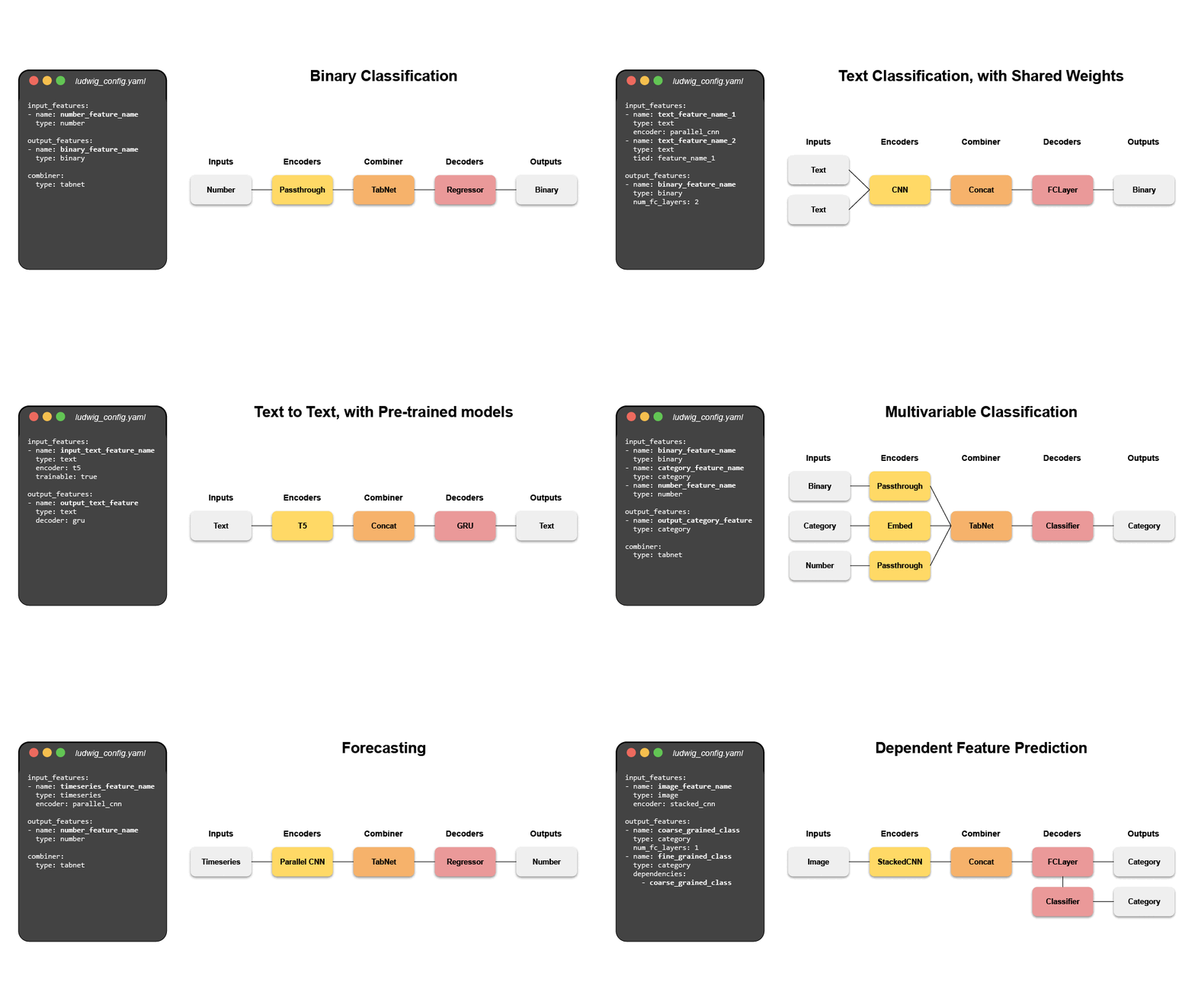
- 🛠 Build custom models with ease: a declarative YAML configuration file is all you need to train a state-of-the-art LLM on your data. Support for multi-task and multi-modality learning. Comprehensive config validation detects invalid parameter combinations and prevents runtime failures.
- ⚡ Optimized for scale and efficiency: automatic batch size selection, distributed training (DDP, DeepSpeed), parameter efficient fine-tuning (PEFT), 4-bit quantization (QLoRA), torchao QAT, multi-adapter PEFT, GRPO reward-based alignment, and larger-than-memory datasets.
- 📐 Expert level control: retain full control of your models down to the activation functions. Support for hyperparameter optimization, explainability, and rich metric visualizations.
- 🧱 Modular and extensible: experiment with different model architectures, tasks, features, and modalities with just a few parameter changes in the config. Think building blocks for deep learning.
- 🚢 Engineered for production: prebuilt Docker containers, native support for running with Ray on Kubernetes, export models to Torchscript and Triton, upload to HuggingFace with one command.
Ludwig is hosted by the Linux Foundation AI & Data.
Tech stack: Python 3.12 | PyTorch 2.6 | Pydantic 2 | Transformers 5 | Ray 2.54
💾 Installation
Install from PyPI. Be aware that Ludwig requires Python 3.12+.
pip install ludwig
Or install with all optional dependencies:
pip install ludwig[full]
🏃 Quick Start
For a full tutorial, check out the official getting started guide, or take a look at end-to-end Examples.
Large Language Model Fine-Tuning

Let's fine-tune a pretrained LLM to follow instructions like a chatbot ("instruction tuning").
Prerequisites
- HuggingFace API Token
- Access approval to your chosen base model (e.g., Llama-3.1-8B)
- GPU with at least 12 GiB of VRAM (in our tests, we used an Nvidia T4)
Running
We'll use the Stanford Alpaca dataset, which will be formatted as a table-like file that looks like this:
| instruction | input | output |
|---|---|---|
| Give three tips for staying healthy. | 1.Eat a balanced diet and make sure to include... | |
| Arrange the items given below in the order to ... | cake, me, eating | I eating cake. |
| Write an introductory paragraph about a famous... | Michelle Obama | Michelle Obama is an inspirational woman who r... |
| ... | ... | ... |
Create a YAML config file named model.yaml with the following:
model_type: llm
base_model: meta-llama/Llama-3.1-8B

quantization:
  bits: 4

adapter:
  type: lora

prompt:
  template: |
    Below is an instruction that describes a task, paired with an input that may provide further context.
    Write a response that appropriately completes the request.

    ### Instruction:
    {instruction}

    ### Input:
    {input}

    ### Response:

input_features:
  - name: prompt
    type: text

output_features:
  - name: output
    type: text

trainer:
  type: finetune
  learning_rate: 0.0001
  batch_size: 1
  gradient_accumulation_steps: 16
  epochs: 3
  learning_rate_scheduler:
    warmup_fraction: 0.01

preprocessing:
  sample_ratio: 0.1
And now let's train the model:
ludwig train --config model.yaml --dataset "ludwig://alpaca"
Supervised ML
Let's build a neural network that predicts whether a given movie critic's review on Rotten Tomatoes was positive or negative.
Our dataset will be a CSV file that looks like this:
| movie_title | content_rating | genres | runtime | top_critic | review_content | recommended |
|---|---|---|---|---|---|---|
| Deliver Us from Evil | R | Action & Adventure, Horror | 117.0 | TRUE | Director Scott Derrickson and his co-writer, Paul Harris Boardman, deliver a routine procedural with unremarkable frights. | 0 |
| Barbara | PG-13 | Art House & International, Drama | 105.0 | FALSE | Somehow, in this stirring narrative, Barbara manages to keep hold of her principles, and her humanity and courage, and battles to save a dissident teenage girl whose life the Communists are trying to destroy. | 1 |
| Horrible Bosses | R | Comedy | 98.0 | FALSE | These bosses cannot justify either murder or lasting comic memories, fatally compromising a farce that could have been great but ends up merely mediocre. | 0 |
| ... | ... | ... | ... | ... | ... | ... |
Download a sample of the dataset from here.
wget https://ludwig.ai/latest/data/rotten_tomatoes.csv
Next create a YAML config file named model.yaml with the following:
input_features:
  - name: genres
    type: set
    preprocessing:
      tokenizer: comma
  - name: content_rating
    type: category
  - name: top_critic
    type: binary
  - name: runtime
    type: number
  - name: review_content
    type: text
    encoder:
      type: embed
output_features:
  - name: recommended
    type: binary
That's it! Now let's train the model:
ludwig train --config model.yaml --dataset rotten_tomatoes.csv
Happy modeling
Try applying Ludwig to your data. Reach out if you have any questions.
❓ Why you should use Ludwig
- Minimal machine learning boilerplate
Ludwig takes care of the engineering complexity of machine learning out of
the box, enabling research scientists to focus on building models at the
highest level of abstraction. Data preprocessing, hyperparameter
optimization, device management, and distributed training for
torch.nn.Module models come completely free.
- Easily build your benchmarks
Creating a state-of-the-art baseline and comparing it with a new model is a simple config change.
- Easily apply new architectures to multiple problems and datasets
Apply new models across the extensive set of tasks and datasets that Ludwig supports. Ludwig includes a full benchmarking toolkit accessible to any user, for running experiments with multiple models across multiple datasets with just a simple configuration.
- Highly configurable data preprocessing, modeling, and metrics
Any and all aspects of the model architecture, training loop, hyperparameter search, and backend infrastructure can be modified as additional fields in the declarative configuration to customize the pipeline to meet your requirements. For details on what can be configured, check out Ludwig Configuration docs.
- Multi-modal, multi-task learning out-of-the-box
Mix and match tabular data, text, images, and even audio into complex model configurations without writing code.
- Rich model exporting and tracking
Automatically track all trials and metrics with tools like Tensorboard, Comet ML, Weights & Biases, MLFlow, and Aim Stack.
- Automatically scale training to multi-GPU, multi-node clusters
Go from training on your local machine to the cloud without code changes.
- Low-code interface for state-of-the-art models, including pre-trained Huggingface Transformers
Ludwig also natively integrates with pre-trained models, such as the ones available in Huggingface Transformers. Users can choose from a vast collection of state-of-the-art pre-trained PyTorch models to use without needing to write any code at all. For example, training a ModernBERT-based sentiment analysis model with Ludwig is as simple as:
ludwig train --dataset sst5 --config_str "{input_features: [{name: sentence, type: text, encoder: {type: bert, pretrained_model_name_or_path: answerdotai/ModernBERT-base}}], output_features: [{name: label, type: category}]}"
- Low-code interface for AutoML
Ludwig AutoML allows users to obtain trained models by providing just a dataset, the target column, and a time budget.
auto_train_results = ludwig.automl.auto_train(dataset=my_dataset_df, target=target_column_name, time_limit_s=7200)
- Easy productionisation
Ludwig makes it easy to serve deep learning models, including on GPUs. Launch a REST API for your trained Ludwig model.
ludwig serve --model_path=/path/to/model
Ludwig supports exporting models to efficient Torchscript bundles.
ludwig export_torchscript -–model_path=/path/to/model
🗂️ Task Gallery
Ludwig ships with 500+ built-in datasets covering every major ML task. Each dataset can be
loaded with a single command: ludwig datasets download <name> or from ludwig.datasets import <name>.
Pick a task below to see the config.
Classify text into categories — topics, intents, sentiments, or arbitrary labels.
# Dataset: amazon_massive_intent — multilingual intent classification (51 languages, 60 intents)
# ludwig datasets download amazon_massive_intent
input_features:
  - name: utt
    type: text
output_features:
  - name: intent
    type: category
Other datasets: agnews, clinc_oos, banking77, aegis_safety, go_emotions
Predict a continuous numeric score from text — star ratings, quality scores, relevance.
# Dataset: app_reviews — predict 1-5 star rating from mobile app review text (288K examples)
# ludwig datasets download app_reviews
input_features:
  - name: review
    type: text
    encoder:
      type: bert
      trainable: true
output_features:
  - name: star
    type: number
trainer:
  epochs: 5
  learning_rate: 1.0e-5
Other datasets: amazon_reviews_2023, civil_comments (toxicity), bookprice_prediction
Generate a concise summary from a long document or article.
# Dataset: cnn_dailymail — news article → bullet-point highlights (287K examples)
# ludwig datasets download cnn_dailymail
input_features:
  - name: article
    type: text
    encoder:
      type: auto_transformer
      pretrained_model_name_or_path: facebook/bart-base
      trainable: true
      max_sequence_length: 512
output_features:
  - name: highlights
    type: text
    decoder:
      type: generator
      max_new_tokens: 128
trainer:
  epochs: 3
  batch_size: 4
  gradient_accumulation_steps: 8
  learning_rate: 5.0e-5
Other datasets: arxiv_summarization, big_patent, aeslc, billsum, dialogsum, xsum
Tag each token in a sentence with its entity type (person, organisation, location, …).
# Dataset: conll2003 — CoNLL-2003 NER; English newspaper text with PER/ORG/LOC/MISC tags
# ludwig datasets download conll2003
input_features:
  - name: sentence
    type: text
    encoder:
      type: bert
      pretrained_model_name_or_path: answerdotai/ModernBERT-base
      trainable: true
      reduce_output: null
output_features:
  - name: ner_tags
    type: sequence
    decoder:
      type: tagger
trainer:
  epochs: 10
  learning_rate: 2.0e-5
  batch_size: 32
Other datasets: wikiann_en, wikiann_de, multinerd, few_nerd, wnut17, ncbi_disease
Given a passage and a question, extract or generate the answer.
# Dataset: squad — Stanford QA Dataset; 100K passage + question → answer span examples
# ludwig datasets download squad
input_features:
  - name: context
    type: text
    encoder:
      type: auto_transformer
      pretrained_model_name_or_path: google-bert/bert-base-uncased
      trainable: true
  - name: question
    type: text
    encoder:
      type: auto_transformer
      pretrained_model_name_or_path: google-bert/bert-base-uncased
      trainable: true
output_features:
  - name: answers
    type: text
    decoder:
      type: generator
      max_new_tokens: 32
combiner:
  type: concat
trainer:
  epochs: 5
  learning_rate: 2.0e-5
Other datasets: squad_v2, natural_questions, hotpot_qa, drop, ambig_qa, nq_open, arc_challenge
Translate text from one language to another using sequence-to-sequence transformer models.
# Dataset: opus100_en_de — OPUS-100 English-German parallel corpus (1M sentence pairs)
# ludwig datasets download opus100_en_de
input_features:
  - name: en
    type: text
    encoder:
      type: auto_transformer
      pretrained_model_name_or_path: facebook/mbart-large-cc25
      trainable: true
      max_sequence_length: 128
output_features:
  - name: de
    type: text
    decoder:
      type: generator
      max_new_tokens: 128
trainer:
  epochs: 3
  batch_size: 16
  gradient_accumulation_steps: 4
  learning_rate: 3.0e-5
Other datasets: opus100_en_fr, opus100_en_es, wmt14_de_en, bornholm_bitext
Classify whether a hypothesis entails, contradicts, or is neutral given a premise.
# Dataset: mnli — Multi-Genre NLI; premise + hypothesis → entailment/neutral/contradiction (393K examples)
# ludwig datasets download mnli
input_features:
  - name: premise
    type: text
    encoder:
      type: bert
      pretrained_model_name_or_path: answerdotai/ModernBERT-base
      trainable: true
  - name: hypothesis
    type: text
    encoder:
      type: bert
      pretrained_model_name_or_path: answerdotai/ModernBERT-base
      trainable: true
output_features:
  - name: label
    type: category
combiner:
  type: concat
trainer:
  epochs: 5
  learning_rate: 2.0e-5
  batch_size: 32
Other datasets: qnli, rte, snli, wnli, anli, belebele
Score how semantically similar two sentences are on a continuous scale.
# Dataset: stsb — Semantic Textual Similarity Benchmark; sentence pairs rated 0–5 (8.6K examples)
# ludwig datasets download stsb
input_features:
  - name: sentence1
    type: text
    encoder:
      type: bert
      pretrained_model_name_or_path: answerdotai/ModernBERT-base
      trainable: true
  - name: sentence2
    type: text
    encoder:
      type: bert
      pretrained_model_name_or_path: answerdotai/ModernBERT-base
      trainable: true
output_features:
  - name: score
    type: number
combiner:
  type: concat
trainer:
  epochs: 5
  learning_rate: 2.0e-5
  batch_size: 32
Other datasets: qqp (duplicate questions), paws, sick, biosses (biomedical)
Work with source code as input — detect bugs, generate docstrings, search code.
# Dataset: code_defect_detection — binary bug classification for C/C++ functions (21K examples)
# ludwig datasets download code_defect_detection
input_features:
  - name: func
    type: text
    encoder:
      type: auto_transformer
      pretrained_model_name_or_path: microsoft/codebert-base
      trainable: true
output_features:
  - name: target
    type: binary
trainer:
  epochs: 10
  learning_rate: 2.0e-5
  batch_size: 32
Other datasets: codexglue_code_to_text, code_search_net, mbpp, humaneval, code_alpaca
Classify audio clips by emotion, sound type, intent, or speaker characteristics.
# Dataset: fsd50k — FSD50K; 200-class audio event classification (51K clips)
# ludwig datasets download fsd50k
input_features:
  - name: audio
    type: audio
    encoder:
      type: auto_transformer
      pretrained_model_name_or_path: facebook/wav2vec2-base
      trainable: true
output_features:
  - name: labels
    type: set
trainer:
  epochs: 20
  batch_size: 16
  learning_rate: 1.0e-5
Other datasets: emodb (emotions), esc50 (50 environmental sounds), audioset, birdset, minds14
Transcribe spoken audio to text.
# Dataset: librispeech — English speech from audiobooks; clean 100h split
# ludwig datasets download librispeech
input_features:
  - name: audio
    type: audio
    encoder:
      type: auto_transformer
      pretrained_model_name_or_path: facebook/wav2vec2-base
      trainable: true
output_features:
  - name: text
    type: text
    decoder:
      type: generator
trainer:
  epochs: 10
  learning_rate: 1.0e-5
Other datasets: fleurs_en, multilingual_librispeech, voxpopuli, peoples_speech, cantonese_asr
Assign a category label to an image.
# Dataset: eurosat_rgb — Sentinel-2 satellite image land-use classification (10 classes, 27K examples)
# ludwig datasets download eurosat_rgb
input_features:
  - name: image
    type: image
    encoder:
      type: vit
      use_pretrained: true
output_features:
  - name: label
    type: category
trainer:
  epochs: 10
  learning_rate: 1.0e-4
Other datasets: cifar10, cifar100, food101, fashion_mnist, gtsrb, beans, resisc45
Assign a class label to every pixel in an image — land use, building footprints, medical tissue.
# Dataset: satellite_building_segmentation — satellite image building footprint detection
# ludwig datasets download satellite_building_segmentation
input_features:
  - name: image
    type: image
    encoder:
      type: convnextv2
      model_name: convnextv2_tiny
      use_pretrained: true
      trainable: true

output_features:
  - name: mask
    type: image
    decoder:
      type: unet
      num_classes: 2
    loss:
      type: softmax_cross_entropy

preprocessing:
  image:
    height: 256
    width: 256

trainer:
  epochs: 30
  batch_size: 16
  optimizer:
    type: adamw
    lr: 3.0e-4
  use_mixed_precision: true
Other datasets: oxford-iiit-pet (3-class trimap), ADE20K (150 classes), Cityscapes (street scenes)
Answer questions about a document image — invoices, receipts, forms, research papers.
# Dataset: docvqa — DocVQA: document image + question → answer
# ludwig datasets download docvqa
input_features:
  - name: image_path
    type: image
    encoder:
      type: vit
      trainable: true
  - name: question
    type: text
    encoder:
      type: bert
      trainable: true
output_features:
  - name: answer
    type: text
    decoder:
      type: generator
      max_new_tokens: 64
combiner:
  type: concat
trainer:
  epochs: 5
  batch_size: 8
  learning_rate: 1.0e-5
Other datasets: cord_v2, invoice_data, textvqa, merit, vqa_rad
Answer natural-language questions about an image by fusing vision and language understanding.
# Dataset: scienceqa — multimodal science questions with images and answer choices (21K examples)
# ludwig datasets download scienceqa
input_features:
  - name: image
    type: image
    encoder:
      type: vit
      use_pretrained: true
      trainable: true
  - name: question
    type: text
    encoder:
      type: bert
      pretrained_model_name_or_path: answerdotai/ModernBERT-base
      trainable: true
output_features:
  - name: answer
    type: category
combiner:
  type: concat
trainer:
  epochs: 10
  batch_size: 16
  learning_rate: 1.0e-5
Other datasets: mmmu, mathvista, vqa_rad, textvqa
Fine-tune a Vision-Language Model for open-ended image understanding using QLoRA on a single GPU.
# Fine-tune Qwen2-VL on any VQA CSV with columns: image_path, question, answer
model_type: llm
base_model: Qwen/Qwen2-VL-7B-Instruct

is_multimodal: true
trust_remote_code: true

adapter:
  type: lora
  r: 16
  alpha: 32
  target_modules: ["q_proj", "v_proj"]

quantization:
  bits: 4

input_features:
  - name: image_path
    type: image
  - name: question
    type: text

output_features:
  - name: answer
    type: text

trainer:
  type: finetune
  epochs: 3
  batch_size: 4
  gradient_accumulation_steps: 8
  learning_rate: 2.0e-5
  learning_rate_scheduler:
    decay: cosine
    warmup_fraction: 0.03
Other datasets: docvqa, textvqa, mmmu, vqa_rad, cord_v2, scienceqa
Detect harmful, toxic, or unsafe content in text or model outputs.
# Dataset: aegis_safety — NVIDIA Aegis 2.0; 30K prompt+response safety labels
# ludwig datasets download aegis_safety
input_features:
  - name: prompt
    type: text
    encoder:
      type: bert
      pretrained_model_name_or_path: answerdotai/ModernBERT-base
      trainable: true
  - name: response
    type: text
    encoder:
      type: bert
      pretrained_model_name_or_path: answerdotai/ModernBERT-base
      trainable: true
output_features:
  - name: safety_label
    type: category
trainer:
  epochs: 5
  learning_rate: 2.0e-5
  batch_size: 32
Other datasets: civil_comments (toxicity), beavertails, jigsaw_toxicity_pred, factcheck
Train a single model on data from dozens of languages simultaneously.
# Dataset: amazon_massive_intent — 60-intent classification across 51 languages (106K train examples)
# ludwig datasets download amazon_massive_intent
input_features:
  - name: utt
    type: text
    encoder:
      type: auto_transformer
      pretrained_model_name_or_path: google-bert/bert-base-multilingual-cased
      trainable: true
output_features:
  - name: intent
    type: category
trainer:
  epochs: 10
  learning_rate: 2.0e-5
  batch_size: 64
Other datasets: amazon_massive_scenario, wikiann_de, belebele, bornholm_bitext, multilingual_librispeech
Predict a category from structured numeric and categorical columns.
# Dataset: adult_census_income — predict annual income >$50K from census features (48K examples)
# ludwig datasets download adult_census_income
input_features:
  - name: age
    type: number
  - name: workclass
    type: category
  - name: education
    type: category
  - name: occupation
    type: category
  - name: hours-per-week
    type: number
  - name: native-country
    type: category
output_features:
  - name: income
    type: binary
trainer:
  epochs: 20
  batch_size: 128
Other datasets: heart_failure, breast_cancer, forest_cover, mushroom_edibility, otto_group_product
Predict a continuous value from structured data.
# Dataset: ames_housing — predict house sale price from 80 features (1460 examples)
# ludwig datasets download ames_housing
input_features:
  - name: GrLivArea
    type: number
  - name: BedroomAbvGr
    type: number
  - name: FullBath
    type: number
  - name: YearBuilt
    type: number
  - name: Neighborhood
    type: category
output_features:
  - name: SalePrice
    type: number
Other datasets: california_housing, diabetes_regression, wine_quality, allstate_claims_severity
Predict future values of a numeric series from historical observations.
# Dataset: chronos_electricity — hourly electricity demand forecasting
# ludwig datasets download chronos_electricity
input_features:
  - name: demand
    type: timeseries
    preprocessing:
      window_size: 96
    encoder:
      type: patchtst
      patch_size: 16
      patch_stride: 8
      d_model: 128
      num_heads: 8
      num_layers: 3
      output_size: 256

output_features:
  - name: demand
    type: timeseries
    preprocessing:
      horizon: 24
    loss:
      type: huber

trainer:
  epochs: 50
  batch_size: 64
  optimizer:
    type: adamw
    lr: 1.0e-4
Other datasets: gift_eval_pretrain, ETTh1/ETTm2 (electricity transformer temperature benchmarks)
Flag anomalous or fraudulent transactions from structured financial and behavioural features.
# Dataset: creditcard_fraud — 284K transactions; 28 anonymized PCA features + Amount
input_features:
  - name: V1
    type: number
  - name: V2
    type: number
  - name: V3
    type: number
  - name: V4
    type: number
  - name: V14
    type: number
  - name: V17
    type: number
  - name: Amount
    type: number

output_features:
  - name: Class
    type: binary

combiner:
  type: concat
  num_fc_layers: 2
  output_size: 64

trainer:
  epochs: 20
  batch_size: 256
Other datasets: tabular_benchmark_clf, bank_marketing, adult_income_hf
Assign multiple labels simultaneously to a single input.
# Dataset: go_emotions — 28-emotion multi-label classification from Reddit comments (58K examples)
# ludwig datasets download go_emotions
input_features:
  - name: text
    type: text
    encoder:
      type: bert
      trainable: true
output_features:
  - name: labels
    type: set
trainer:
  epochs: 10
  learning_rate: 2.0e-5
Other datasets: audioset (audio events), lex_glue_ecthr, lex_glue_eurlex
Share a single encoder across multiple output tasks — reduce training cost while improving each head.
# Dataset: conll2003 — NER + POS tagging + chunking simultaneously from one model (22K examples)
# ludwig datasets download conll2003
input_features:
  - name: sentence
    type: text
    encoder:
      type: bert
      pretrained_model_name_or_path: answerdotai/ModernBERT-base
      trainable: true
      reduce_output: null

output_features:
  - name: ner_tags
    type: sequence
    decoder:
      type: tagger
  - name: pos_tags
    type: sequence
    decoder:
      type: tagger
  - name: chunk_tags
    type: sequence
    decoder:
      type: tagger

trainer:
  epochs: 10
  learning_rate: 2.0e-5
  batch_size: 32
Other datasets: any dataset with multiple label columns — e.g. NLU datasets with intent + slots
Mix images, text, numbers, and categories as inputs in one model — no custom code required.
# Example: Twitter bot detection — profile image + bio text + engagement stats → bot or human
input_features:
  - name: profile_image_path
    type: image
    encoder:
      type: vit
      use_pretrained: true
  - name: description
    type: text
    encoder:
      type: bert
      trainable: true
  - name: followers_count
    type: number
  - name: statuses_count
    type: number
  - name: verified
    type: binary

output_features:
  - name: account_type
    type: binary

combiner:
  type: concat
  num_fc_layers: 2
  output_size: 128

trainer:
  epochs: 15
  learning_rate: 1.0e-4
Other datasets: hateful-memes (image + caption), product listing classification, medical multimodal
Identify semantic relations between entity mentions within and across sentences.
# Dataset: docred — DocRED; document-level relation extraction from Wikipedia (5053 documents)
# ludwig datasets download docred
input_features:
  - name: title
    type: text
    encoder:
      type: bert
      pretrained_model_name_or_path: answerdotai/ModernBERT-base
      trainable: true
  - name: sents
    type: text
    encoder:
      type: bert
      pretrained_model_name_or_path: answerdotai/ModernBERT-base
      trainable: true
output_features:
  - name: relation
    type: category
combiner:
  type: concat
trainer:
  epochs: 10
  learning_rate: 2.0e-5
  batch_size: 16
Other datasets: tacred, re-tacred, semeval_re, few_rel
Decide whether two audio samples belong to the same speaker.
# Dataset: voxceleb — speaker identification from celebrity interviews (100K+ utterances)
# ludwig datasets download voxceleb
input_features:
  - name: audio
    type: audio
    preprocessing:
      audio_file_length_limit_in_s: 5.0
    encoder:
      type: auto_transformer
      pretrained_model_name_or_path: microsoft/wavlm-base-plus
      trainable: true

output_features:
  - name: speaker_id
    type: category

trainer:
  epochs: 20
  batch_size: 32
  learning_rate: 1.0e-5
Other datasets: librispeech (speaker splits), fleurs_en (per-speaker IDs)
Fine-tune an LLM to follow natural language instructions.
# Dataset: alpaca_gpt4 — 52K GPT-4-generated instruction-following examples
# ludwig datasets download alpaca_gpt4
model_type: llm
base_model: meta-llama/Llama-3.1-8B
quantization:
  bits: 4
adapter:
  type: lora
prompt:
  template: |
    ### Instruction:
    {instruction}

    ### Input:
    {input}

    ### Response:
input_features:
  - name: prompt
    type: text
output_features:
  - name: output
    type: text
trainer:
  type: finetune
  epochs: 3
  learning_rate: 1.0e-4
  batch_size: 1
  gradient_accumulation_steps: 16
Other datasets: alpaca, alpaca_cleaned, databricks_dolly_15k, code_alpaca, coig_cqia
📚 Tutorials
🔬 Example Use Cases
- Named Entity Recognition Tagging
- Natural Language Understanding
- Machine Translation
- Text Summarization
- Text Regression: Rating Prediction
- Chit-Chat Dialogue Modeling through seq2seq
- Question Answering
- Sentiment Analysis
- Content Safety & Toxicity Detection
- Multilingual NLP
- Code Intelligence
- One-shot Learning with Siamese Networks
- Visual Question Answering
- Document Understanding
- Spoken Digit Speech Recognition
- Speaker Verification
- Audio Classification
- Binary Classification (Titanic)
- Timeseries forecasting
- Timeseries forecasting (Weather)
- Movie rating prediction
- Multi-label classification
- Multi-Task Learning
- Simple Regression: Fuel Efficiency Prediction
- Fraud Detection
💡 More Information
Read our publications on Ludwig, declarative ML, and Ludwig’s SoTA benchmarks.
Learn more about how Ludwig works, how to get started, and work through more examples.
If you are interested in contributing, have questions, comments, or thoughts to share, or if you just want to be in the know, please consider joining our Community Discord and follow us on X!
🤝 Join the community to build Ludwig with us
Ludwig is an actively managed open-source project that relies on contributions from folks just like you. Consider joining the active group of Ludwig contributors to make Ludwig an even more accessible and feature rich framework for everyone to use!